
Key takeaways
- Compare connected blood pressure monitors with multi-user memory for caregivers. Find Bluetooth and Wi-Fi models that keep each person's readings apart.
What's inside
As an Amazon Associate I earn from qualifying purchases. This post may contain affiliate links at no extra cost to you.
When you record blood pressure readings for a parent or another relative, the monitor has to do more than take a number. It has to keep that person’s readings apart from yours, send them to your phone without extra steps, and hold a history you can look back on when a clinician asks how things have been going. A single-user monitor mixes everything into one log, and a notebook beside the cuff gets lost, so the real decision is which connected monitor keeps each person’s record separate while staying simple enough for the person wearing the cuff to use alone.
This guide is for family caregivers who take readings for someone else, for adult children who check in on a parent from another home, and for households where two or more people share one monitor. Every monitor below was chosen from the names and specifications shown on its Amazon listing, with multi-user memory and a wireless connection as the two requirements no product could miss.
Quick Picks
As an Amazon Associate we earn from qualifying purchases.
| Product | Best for | Key spec from title |
|---|---|---|
| Omron 10 Series BP7450 | Two-person households that want averaged readings | TruRead three-reading average, 200 readings for two users |
| Omron Platinum BP5450 | Caregivers who want rhythm screening on every reading | AFib screening, 200 readings for two users |
| Omron Gold BP5360 | Caregivers who want AFib screening in a simpler unit | AFib screening, 160 readings for two users |
| Withings BPM Connect | Caregivers who want Wi-Fi sync without a phone nearby | Wi-Fi and Bluetooth sync, rechargeable battery |
| Beurer BM67 | Households with four people to track | Four user slots, 30 readings each |
How to Choose
How many user profiles the monitor keeps apart
The first number to check is how many people get their own memory on the device itself. Two-user monitors suit a caregiver and one parent, or a couple who share a home, because each person picks a profile before the cuff inflates and the readings land in separate logs. Four-user monitors suit a larger household where several relatives take turns with the same cuff. Watch the split as well as the total: a monitor that holds 200 readings sounds generous, but if those readings divide into 100 per person, a household of four will run out of room fast. App storage is usually unlimited, yet on-device memory matters on days when nobody opens the app.
How readings reach the caregiver’s phone
Bluetooth sync works well when the caregiver is in the same home, since the phone needs to be near the monitor when readings move across. Wi-Fi sync suits a caregiver who lives elsewhere, because readings can travel to the app even when the phone is in another room or switched off. Some monitors work with a voice assistant, which lets a parent ask for a recent reading out loud instead of opening an app. Before buying, confirm the companion app runs on the phones in your household and supports more than one profile, since a monitor with two on-device users can still funnel every synced reading into a single app account.
Cuff fit and the arm it will be measured on
A cuff that does not fit the arm gives numbers that mean little, so measure the upper arm before choosing a monitor. Most monitors in this guide ship with a cuff that fits arms from 9 to 17 inches, which covers most adults, while a few use a narrower cuff that ends near 16.5 inches. A pre-formed cuff that holds its shape is easier for an older person to slide on one-handed, and a D-ring cuff lets the wearer tighten it with a single pull. If two people with very different arm sizes share one monitor, check whether the maker sells a second cuff size that fits the same unit, and confirm which cuff is in the box.
What the monitor shows on its own screen
A caregiver is not always standing beside the monitor, so the screen has to speak clearly to the person wearing the cuff. Large digits matter for anyone with weak eyesight, and a backlit display helps in a dim bedroom. Some monitors show the previous reading next to the current one, which lets the person see change at a glance without opening the app. Others show only the latest reading and keep the history in the app, which is fine when the caregiver checks the phone daily but less helpful when the person measured wants reassurance in the moment. Averaging features also help here: a monitor that takes three readings and shows the average removes the worry of one odd number.
The 5 Best Options
Omron 10 Series BP7450

The 10 Series is the workhorse of this group, and it suits a caregiver who wants a dependable two-user monitor with a clear screen and a useful averaging feature. Its TruRead function takes three consecutive readings and shows the average, which takes the guesswork out of deciding which number to write down. The dual backlit display puts the last reading beside the current one, so the person wearing the cuff can see how today compares with yesterday without touching a phone. Bluetooth sync moves readings into the Omron Connect app, where storage is unlimited and more users can be added.
Specs
- Easy-Wrap ComFit cuff fits arms from 9 to 17 inches
- Stores 200 readings on the device, 100 for each of two users
- Bluetooth sync to the free Omron Connect app for iOS and Android
- TruRead takes three consecutive readings and displays the average
- Dual backlit LCD shows the previous reading next to the current one
- Irregular heartbeat indicator and hypertension indicator on the display
- Runs on 4 AA batteries, included, with an AC adapter in the box
- Five-year limited warranty on the monitor
Best for: A caregiver and one parent who share a monitor and want averaged readings on a large, easy-to-read screen.
Watch out for: Bluetooth works only with selected iOS and Android devices, so confirm the phones in your household are on the maker’s compatibility list before ordering.
Omron Platinum BP5450

The Platinum adds a rhythm screening feature to the same two-user, Bluetooth formula, which makes it the pick for a caregiver who wants each reading to flag a possible irregular rhythm for discussion with a clinician. It keeps the wide D-ring cuff, the dual display, and the 200-reading memory of the 10 Series, then adds a morning hypertension indicator and a morning average feature that highlight readings taken soon after waking. Readings sync to the Omron Connect app over Bluetooth, where they can be charted and shared, and the included storage case keeps the monitor and cuff together between uses.
Specs
- Wide-range D-ring cuff fits arms from 9 to 17 inches
- Stores 200 readings on the device, 100 for each of two users
- Bluetooth sync to the free Omron Connect app for iOS and Android
- AFib screening feature flags a possible irregular rhythm on every reading
- Morning hypertension indicator and morning average feature
- High-contrast backlit dual display with large digits
- Runs on 4 AA batteries, included, with an AC adapter and storage case in the box
- Five-year limited warranty on the monitor
Best for: A caregiver who wants rhythm screening on every reading plus morning pattern alerts for the person they look after.
Watch out for: If systolic pressure is above 210 mmHg, the manual says to press and hold the button until the cuff inflates higher than the expected systolic number, which is worth knowing before the first use.
Omron Gold BP5360
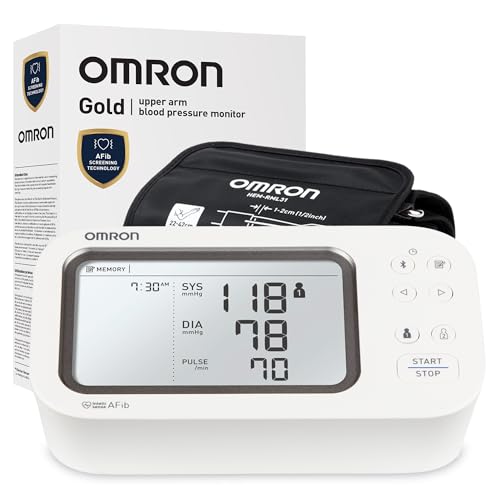
The Gold carries the same AFib screening feature as the Platinum in a simpler unit, which suits a caregiver who wants that screening without paying for the Platinum’s extra averaging functions. It stores 160 readings across two users, 80 each, and syncs them to the Omron Connect app over Bluetooth, where storage is unlimited and trends can be charted and shared with family or a clinician. The wide-range D-ring cuff fits arms from 9 to 17 inches, the High Morning Average indicator flags morning readings in the hypertensive range, and a guest mode lets a visitor take a reading without touching either stored profile.
Specs
- Wide-range D-ring cuff fits arms from 9 to 17 inches
- Stores 160 readings on the device, 80 for each of two users
- Bluetooth sync to the free Omron Connect app for iOS and Android
- AFib screening feature flags a possible irregular rhythm on every reading
- High Morning Average indicator for readings taken after waking
- Guest mode for a reading that should not enter either profile
- Runs on 4 AA batteries, included, with a storage case in the box
- Sold exclusively on Amazon and backed by a five-year warranty
Best for: A caregiver who wants AFib screening and two-user memory in the simplest Omron unit that still syncs to an app.
Watch out for: No AC adapter is included in the box, so the monitor runs on batteries unless you buy an adapter separately, and the display has no backlight.
Withings BPM Connect

The Withings BPM Connect is the only monitor here that syncs over Wi-Fi as well as Bluetooth, which makes it the pick for a caregiver who does not live with the person being measured. Readings travel to the Health Mate app on their own once the monitor joins the home Wi-Fi network, so no phone needs to be nearby when the cuff inflates. The app supports multiple user profiles, the device gives immediate color-coded feedback on its LED display, and the rechargeable battery lasts for months between charges. The cuff, pump, and display form one compact unit that stores neatly in a drawer.
Specs
- Wi-Fi and Bluetooth sync to the free Health Mate app for iOS and Android
- Multiple user profiles in the app keep each person’s history separate
- Cuff fits arms from 9 to 17 inches
- LED matrix display with color-coded feedback after each reading
- Measures systolic and diastolic pressure plus heart rate
- Rechargeable battery with months of use between charges, micro-USB cable included
- Stores up to 8 readings on the device when away from Wi-Fi or Bluetooth
- FSA and HSA eligible
Best for: A caregiver who lives elsewhere and wants readings to arrive in the app without anyone needing a phone beside the monitor.
Watch out for: Only 8 readings are stored on the device itself, so the monitor needs regular Wi-Fi or Bluetooth contact with the app, or older readings will be overwritten.
Beurer BM67

The Beurer BM67 is the only monitor here with four on-device user slots, which makes it the pick for a household where several relatives share one cuff. Each of the four users gets 30 stored readings, and Bluetooth sync sends readings to the companion app for unlimited storage and trend charts. The XL LCD display uses large digits that are easy to read at a glance, the cuff fits arms from 8.6 to 16.5 inches, and an irregular heartbeat indicator appears on the screen during measurement. Batteries and a storage case are included in the box, so it works straight away.
Specs
- Four user slots with 30 stored readings for each user
- Bluetooth sync to the companion app for unlimited storage
- Universal cuff fits arms from 8.6 to 16.5 inches
- XL LCD display with large, easy-to-read digits
- Irregular heartbeat indicator shown during measurement
- Automatic switch-off after use
- Runs on 4 AA batteries, included, with a storage case in the box
Best for: A household of three or four people who each need their own reading history on one shared monitor.
Watch out for: No independent validation for this exact model could be verified, and 30 readings per user is the smallest memory in this guide, so regular app syncing matters more here.
Which One Fits Your Situation
You record readings for one parent while living elsewhere
Pick the Withings BPM Connect. Its Wi-Fi sync sends readings to the Health Mate app without a phone needing to be near the monitor, so you can check a parent’s numbers from your own home. The color-coded display gives the parent immediate feedback after each reading, and the rechargeable battery means nobody has to keep buying batteries.
Two people in the house share one monitor
Pick the Omron 10 Series BP7450 or the Omron Platinum BP5450. Both hold 100 readings for each of two users and sync to the Omron Connect app, so neither person’s history mixes with the other’s. Choose the 10 Series if averaged readings matter most to you, and the Platinum if you also want rhythm screening and morning pattern alerts.
Four family members need their own history
Pick the Beurer BM67. It is the only monitor in this guide with four on-device user slots, giving each person 30 stored readings of their own. Bluetooth sync moves those readings into the app for a longer history, and the large display suits a shared monitor that passes from one person to the next.
The person being measured dislikes phones and apps
Pick the Omron Gold BP5360 or the Omron 10 Series BP7450. Both work fully without a phone: readings appear on a large display, the memory holds weeks of readings for two users, and the cuff is easy to wrap with one hand. The caregiver can sync the readings to the app later, on a visit, instead of asking the person measured to manage any technology.
Common Mistakes
- Buying a single-user monitor for a household where two or more people will be measured, then finding every reading mixed into one log.
- Skipping the arm measurement and discovering the included cuff is too small or too large for the person who will wear it most.
- Assuming Bluetooth sync happens on its own, when the phone must be nearby and the app open for readings to move across on some models.
- Forgetting to select the right user profile before the cuff inflates, so a reading lands in the wrong person’s history.
- Treating one high number as a verdict instead of looking at the trend across a week of readings taken at similar times of day.
Frequently Asked Questions
Can one monitor keep two people’s readings separate?
Yes, when the monitor has two or more user profiles. Each person selects a profile before measuring, and the monitor stores their readings in separate memory banks. The Omron models here hold 80 to 100 readings per user, the Beurer holds 30 per user for four users, and the Withings app keeps profiles separate in the cloud.
Does the caregiver need to be in the room when a reading is taken?
No. With a Wi-Fi monitor such as the Withings BPM Connect, readings reach the app without anyone nearby. With Bluetooth models, the phone must be close to the monitor at sync time, but the caregiver can sync later on a visit, since the monitor stores readings on the device until then.
What if the person measured has a larger arm?
Measure the upper arm first, then match it to the cuff range in the listing. Most monitors here fit arms from 9 to 17 inches, while the Beurer cuff ends at 16.5 inches. If an arm falls outside the included range, check whether the maker sells a larger cuff that fits the same monitor before buying.
Do these monitors work without a phone?
Yes. Every monitor in this guide takes readings and shows the result on its own display with no phone involved. The phone only adds history, charts, and sharing. On-device memory holds between 30 and 100 readings per user, depending on the model, so syncing can wait until the caregiver’s next visit.
Related guides
More from Amazon
Programs that pair well with the guide above. Offers and eligibility are set by Amazon and may change.
Set up recurring deliveries of everyday items on eligible products. Terms and savings are set by Amazon.
Explore Subscribe & SaveFree shipping on eligible items, Prime Video and more. Eligible new members can start with a free trial.
Start a Prime free trialAudiobooks and podcasts to listen to on the go. Eligible new members can start with a free trial.
Try Audible freeRead from a large library of eBooks and audiobooks on any device. Check Amazon for current plans.
Explore Kindle UnlimitedAs an Amazon Associate we earn from qualifying purchases.
Write Your Review
No reviews yet. Be the first to share your experience!