
Key takeaways
- Compare 5 smartphone-connected blood pressure monitors for shared household use, with multi-user storage, app sync, and simple shared-device organization.
What's inside
As an Amazon Associate I earn from qualifying purchases. This post may contain affiliate links at no extra cost to you.
One blood pressure monitor shared by a whole household sounds simple until the readings pile up in one undifferentiated list. A partner checks in the morning, a parent checks after lunch, and by the end of the week nobody can tell whose numbers belong to whom. A smartphone-connected monitor changes that equation, because the phone app can sort, label, and store each reading under the right person instead of leaving everything jumbled on one small screen.
This guide is for households where two or more people use the same device: couples who both keep an eye on their numbers, adult children helping a parent track readings, and families who want one cuff in one agreed spot rather than a drawer full of gadgets. Every monitor below was chosen from its Amazon listing title and listed specifications, with attention to how many people it can store, how readings move to a phone, and how easily the device and cuff stay organized between uses.
Quick Picks
As an Amazon Associate we earn from qualifying purchases.
| Product | Best for | Key spec from title |
|---|---|---|
| OMRON Platinum BP5465 | Two people sharing one device daily | Two-user memory with 100 readings per user |
| OMRON Evolv BP7000 | A household that wants one tidy, portable unit | One-piece wireless design with Bluetooth sync |
| Withings BPM Connect WPM05 | Phone-first households with Wi-Fi at home | Wi-Fi and Bluetooth sync to the Health Mate app |
| OMRON Silver BP5255 | One main user with occasional sharing | Bluetooth sync with 30-reading on-device storage |
| iHealth Track KN-550BT | A budget-friendly shared cuff for standard to large arms | Wide-range cuff with Bluetooth for iOS and Android |
How to Choose
Count the people before you count the features
A shared monitor lives or dies on how it separates one person’s readings from another’s. Some models hold two named users on the device itself, with a set number of readings stored for each, while others keep a single on-device list and rely on the phone app to sort things out. If two people check daily, a two-user memory of 100 readings each gives each person months of history before anything is overwritten. If only one person checks regularly and the second checks now and then, a single-user device with app sync can still work, as long as the occasional user syncs promptly.
Decide how readings should reach the phone
Bluetooth sync is the standard route: the monitor sends each reading to a nearby phone running the companion app. Wi-Fi adds a second route, letting the monitor upload readings even when the measuring phone is not in the room, which helps when one person measures and another manages the household records. Either way, look at what the app actually stores. Unlimited app storage means the phone keeps a long history even after the device memory fills up, and a share function lets a household member send a reading log to a clinician or a family member.
Match the cuff to every arm that will use it
A cuff that fits one person poorly will produce awkward measurements for everyone else, and a shared household almost always has more than one arm size. Pre-formed cuffs in the 9 to 17 inch range cover standard and large adult arms, while integrated cuffs measured in centimetres, such as 22 to 42 cm, cover a similar span in a different unit. Before buying, measure each regular user’s upper arm at its widest point and compare the result with the cuff range printed on the listing. A cuff that is too small or too large is a common source of frustration, so getting the range right before ordering saves a return.
Plan where the device will live between uses
A shared device needs a home, not a hiding place. Models that ship with a storage case keep the cuff, monitor, and cables together, which matters when the device moves between a bedroom, a kitchen counter, and a living room shelf. One-piece designs with no separate tubes or wires are the easiest to put away, because there is nothing to coil and nothing to snag. Battery-powered models go anywhere, while models with an included AC adapter suit a fixed spot near an outlet. Agree on one shelf or drawer, keep the charger or spare batteries there too, and the next person will always find the monitor ready.
The 5 Best Options
OMRON Platinum BP5465

The Platinum is the most household-ready monitor in this group because its two-user memory is built for exactly the situation this guide covers. Each of the two users gets 100 stored readings on the device, so a couple checking daily can go for months without overwriting each other’s history. Bluetooth sync moves readings into the OMRON connect app, where the longer record lives and can be shared. A high-contrast backlit display keeps the numbers easy to read in a dim bedroom, and the included AC adapter means the device can stay plugged in at its agreed spot.
Specs
- Model BP5465, upper-arm monitor with Bluetooth sync to the OMRON connect app
- Two-user memory, 100 readings stored per user, 200 readings in total
- Easy-Wrap ComFit cuff fits upper arms from 9 to 17 inches
- High-contrast backlit display
- AFib screening feature listed on the product page
- AC adapter included; also compatible with Apple Health and Google Fit
Best for: Two people who check daily and want separate on-device histories without sorting readings by hand.
Watch out for: The two-user memory is a device feature, so confirm both users are set up on the monitor before the first week of use, or early readings may land in the wrong slot.
OMRON Evolv BP7000

The Evolv suits households that value tidiness, because the monitor and cuff are a single piece with no tubes, wires, or separate unit to keep track of. One button begins a measurement, and Bluetooth sync sends the result to the OMRON connect app, where readings can be stored and tracked over time. The device stores up to 100 readings on its own, and the app holds a longer history. A storage case is included, so the whole unit slips into a drawer or bag as one item and comes out the same way.
Specs
- Model BP7000, one-piece wireless upper-arm monitor with Bluetooth
- Syncs with the OMRON connect app to store readings and track trends
- Stores up to 100 readings on the device
- Advanced Accuracy technology listed on the product page
- Irregular heartbeat detection listed on the product page
- Storage case included
Best for: A household that wants the simplest possible shared device, with nothing to assemble and nothing loose to lose.
Watch out for: The one-piece design means the cuff size is fixed to the unit, so check the listed arm range against every regular user before buying.
Withings BPM Connect WPM05

The Withings BPM Connect is the phone-first pick, because it syncs over both Wi-Fi and Bluetooth to the Health Mate app. Wi-Fi sync is genuinely useful in a shared home: readings upload automatically even when the phone that measured them is in another room, and the app keeps the history organized by account. The monitor shows colour-coded feedback on its display, and the integrated cuff covers 22 to 42 cm. A rechargeable battery removes the need to keep spare batteries in the storage spot.
Specs
- Model WPM05, upper-arm monitor with Wi-Fi and Bluetooth sync
- Syncs to the Health Mate app for iOS and Android
- Integrated cuff range of 22 to 42 cm
- Colour-coded feedback on the display
- Measures systolic and diastolic pressure plus heart rate
- Rechargeable battery with USB charging
Best for: Households where one person manages the records on a phone and wants readings to arrive without manual syncing.
Watch out for: Wi-Fi setup happens in the app, so have the home network name and password ready during setup, and confirm each household member signs in to the correct Health Mate account.
OMRON Silver BP5255
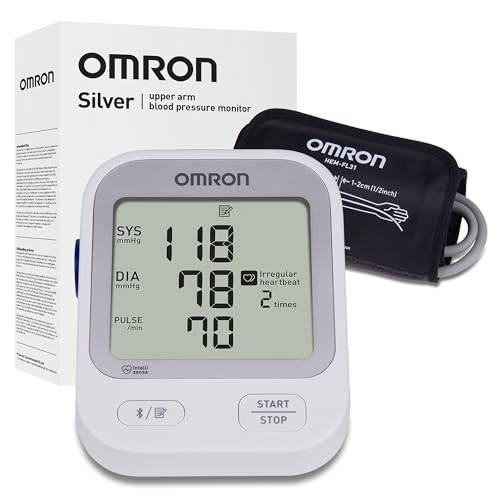
The Silver is the straightforward pick for a household with one main user and a second person who checks occasionally. Bluetooth sync sends readings to the OMRON connect app, where storage is unlimited, while the device itself holds 30 readings for one user. The extra-large LCD is easy to read, and the pre-formed Easy-Wrap ComFit cuff fits arms from 9 to 17 inches. A storage case is included, which helps a shared device stay together between uses.
Specs
- Model BP5255, upper-arm monitor with Bluetooth sync to the OMRON connect app
- Stores up to 30 readings on the device; unlimited storage in the app
- Easy-Wrap ComFit cuff fits upper arms from 9 to 17 inches
- Extra-large LCD screen
- Irregular heartbeat detection listed on the product page
- Runs on four AA batteries, included; storage case included
Best for: One regular user plus an occasional second user who syncs to the app after each check.
Watch out for: On-device memory holds one user only, so the occasional user should sync to the app right away, or their readings will sit in the same on-device list as the main user’s.
iHealth Track KN-550BT
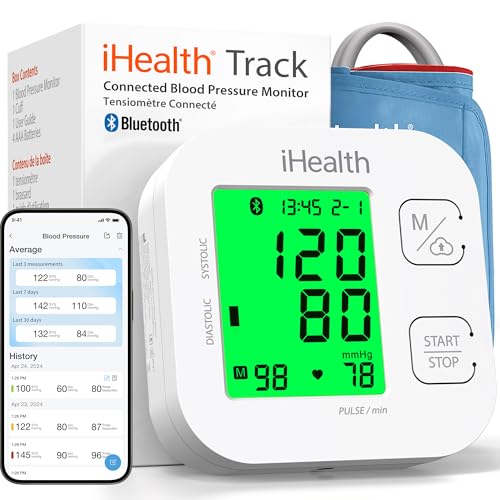
The iHealth Track is the low-cost way to put a connected monitor in a shared home without overthinking the setup. Bluetooth sync sends readings to the iHealth MyVitals app on iOS and Android, and the device itself stores 60 readings. The wide-range cuff is made to fit standard to large adult arms, which suits households where arm sizes differ. A large, clear display shows the numbers at a glance, and the unit runs on four AAA batteries.
Specs
- Model KN-550BT, upper-arm monitor with Bluetooth sync
- Syncs with the iHealth MyVitals app for iOS and Android
- Wide-range cuff fits standard to large adult arms
- Stores up to 60 readings on the device
- Large LCD display with colour-coded indicators
- Runs on four AAA batteries, required
Best for: A household that wants an affordable connected monitor and a cuff that fits a wide range of arm sizes.
Watch out for: Syncing needs the app open and the phone nearby, so agree that each person syncs right after measuring, or readings may pile up unsynced on the device.
Which One Fits Your Situation
Two partners check every day
Pick the OMRON Platinum BP5465. Its two-user memory keeps each partner’s 100 readings separate on the device, and Bluetooth sync carries both histories into the app without any manual sorting. The backlit display helps with early-morning checks, and the AC adapter suits a fixed spot on a bedroom shelf where both partners can reach it.
One person manages the records for everyone
Pick the Withings BPM Connect WPM05. Wi-Fi sync means readings arrive in the Health Mate app even when the measuring phone is elsewhere, so the household record-keeper sees everything in one place. The rechargeable battery and integrated cuff also keep the storage spot free of spare batteries and loose parts.
The device travels between rooms or homes
Pick the OMRON Evolv BP7000. Its one-piece design has no tubes or separate parts to forget, and the included storage case keeps it protected in a bag or drawer. Bluetooth sync to the OMRON connect app keeps the history intact wherever the device is used, as long as someone syncs it to a phone.
One main user with an occasional second user
Pick the OMRON Silver BP5255 or the iHealth Track KN-550BT. The Silver offers a larger display and a pre-formed cuff, while the iHealth Track offers a wide-range cuff and a lower-cost entry point. Either way, the occasional user should sync to the app after each check so their readings stay separate from the main user’s on-device list.
Common Mistakes
- Letting two people share one on-device user slot, so their readings mix into a single list that nobody can untangle later.
- Buying before measuring every regular user’s arm, then discovering the cuff fits one person and not the other.
- Never opening the companion app, which leaves readings stranded on the device until its memory fills and older entries are overwritten.
- Storing the cuff in one room and the monitor in another, so the device is never complete when someone wants to use it.
- Skipping the Wi-Fi or account setup on day one, which turns a connected monitor into an ordinary standalone unit.
Frequently Asked Questions
Can two people really share one blood pressure monitor?
Yes, and most connected monitors are designed for it. The cleanest setup is a model with two-user on-device memory, such as the OMRON Platinum BP5465, where each person gets a separate stored history. With single-user models, the phone app becomes the separator, so each person should sync to their own app profile right after measuring.
How do I keep each person’s readings separate?
Use the device’s user switch before measuring if it has one, and sync to the companion app after every session. In the app, each person should have their own profile or account, and readings should be checked against the right name before they are shared. A short habit, sync after every check, prevents most mix-ups.
Where is the best place to store a shared monitor?
Choose one fixed spot that every user can reach, such as a bedroom shelf or a hallway drawer, and keep the cuff, charger or spare batteries, and storage case there together. A single agreed location beats a tidy-looking spot that only one person knows about, because the device is only useful if the next person can find it ready to use.
Do I need Wi-Fi for a smartphone-connected monitor?
No. Bluetooth sync covers most households, since the monitor sends readings to a nearby phone running the companion app. Wi-Fi is a convenience, not a requirement: it lets readings upload when the phone is in another room, which helps when one person measures and another manages the records. Check the listing to confirm which connection types each model supports.
Related guides
More from Amazon
Programs that pair well with the guide above. Offers and eligibility are set by Amazon and may change.
Set up recurring deliveries of everyday items on eligible products. Terms and savings are set by Amazon.
Explore Subscribe & SaveFree shipping on eligible items, Prime Video and more. Eligible new members can start with a free trial.
Start a Prime free trialAudiobooks and podcasts to listen to on the go. Eligible new members can start with a free trial.
Try Audible freeRead from a large library of eBooks and audiobooks on any device. Check Amazon for current plans.
Explore Kindle UnlimitedAs an Amazon Associate we earn from qualifying purchases.

Write Your Review
No reviews yet. Be the first to share your experience!