
Our Short List of 3
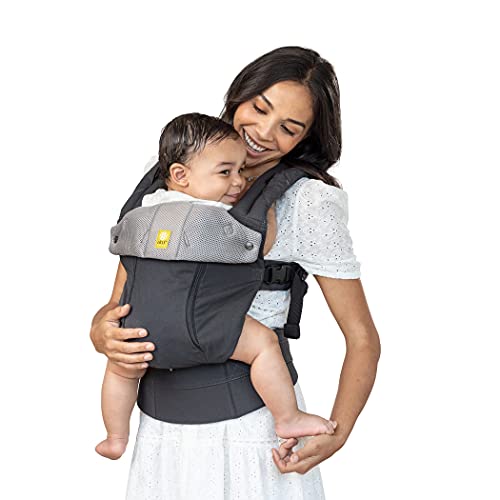
- Best for: Parents who want one carrier with lumbar support that adapts across six positions and all seasons.
- Weight range: 7 to 45 lbs
- Carrying positions: 6-in-1
- Support: lumbar support
- Facing options: inward and outward

- Best for: Warm-weather carrying where airflow matters as much as lumbar support.
- Weight range: 7 to 45 lbs
- Fabric: SoftFlex Mesh
- Support: enhanced lumbar support
- Straps: adjustable cushioned straps

- Best for: Everyday carrying with enhanced lumbar support and no extra hardware to learn.
- Weight range: 7 to 45 lbs
- Support: enhanced lumbar support
- Colour: Black
All 4 Picks at a Glance
| Product | Specs | Action |
|---|---|---|
| LÍLLÉbaby Complete All Seasons Charcoal and Silver |
| Check price on Amazon |
| Ergobaby Omni Breeze Graphite Grey |
| Check price on Amazon |
| Momcozy Purehug Black |
| Check price on Amazon |
 Ergobaby Omni Classic Cool Air Mesh Pearl Grey |
| Check price on Amazon |
Key takeaways
- Compare five baby carriers built for back support, from lumbar pads and wide waist belts to hip-seat load transfer, chosen from Amazon listings.
What's inside
As an Amazon Associate I earn from qualifying purchases. This post may contain affiliate links at no extra cost to you.
A baby carrier can feel wonderful for ten minutes and punishing after an hour, and the difference is rarely the fabric. It is the support hardware underneath: the lumbar pad that fills the curve of your lower back, the waist belt that carries weight on your hips instead of your shoulders, and the straps that spread the load instead of digging into one spot. Two carriers can hold the same child at the same weight and feel completely different, because one transfers the load to your legs and core while the other hangs it from your neck and upper back.
This guide is for parents and caregivers who carry often and want their back to survive the day, from school runs to long walks and airport queues. Every carrier below was chosen from the product names and specifications on its Amazon listing, and the comparison focuses on the support system itself: lumbar pads, waist belts, hip seats, and strap design.
Quick Picks
As an Amazon Associate we earn from qualifying purchases.
| Product | Best for | Key spec from title |
|---|---|---|
| LÍLLÉbaby Complete All Seasons | All-season carrying with a lumbar pad in six positions | 6-in-1 carrier with lumbar support for 7 to 45 lbs |
| Ergobaby Omni Breeze | Hot-weather carrying with cushioned, adjustable straps | SoftFlex Mesh carrier with enhanced lumbar support for 7 to 45 lbs |
| Momcozy Hip Seat | Shifting weight onto a hip seat during long carries | Hip seat carrier with 3D abdominal and lumbar support up to 45 lbs |
| Momcozy Purehug | Simple everyday carrying with enhanced lumbar support | Carrier with enhanced lumbar support for 7 to 45 lbs |
| Ergobaby Omni Classic Cool Air Mesh | One-handed adjustments with a breathable mesh panel | Cool Air Mesh carrier with lumbar support for 7 to 45 lbs |
How to Choose
Start with the lumbar pad, not the fabric
The lumbar pad is the part that decides whether your lower back aches after a long carry. A shaped pad fills the natural curve above your hips and stops the waist belt from pressing into one narrow band of muscle. When you compare carriers, look for a pad that is wide enough to cover the centre of your lower back and firm enough to hold its shape when the belt is tightened. A thin flap of fabric labelled as lumbar support will collapse under load, so treat the pad as the first thing to check and the fabric as a secondary comfort detail.
Check how the waist belt transfers weight
A good waist belt moves most of the load from your shoulders to your hips and legs, which are far better built for carrying. The belt should sit on your hip bones rather than your waist, fasten securely without slipping, and stay put when you bend or climb stairs. Wider belts spread pressure over more area, which matters most as your child grows heavier. If the belt rides up toward your ribs or slides down with every step, the shoulder straps end up doing the work, and that is exactly when back pain starts.
Look at the shoulder straps as a pair
Shoulder straps work with the waist belt, not instead of it, and their shape changes how weight reaches your upper back. Wide, cushioned straps spread the remaining load across your shoulders and chest instead of cutting into the muscles near your neck. Adjustable straps matter because a carrier that fits one parent may sit wrong on another, and a strap that cannot be shortened enough will let the child hang too low. Crossed straps suit some wearers, while straight backpack-style straps suit others, so the right choice depends on your build.
Decide whether a hip seat fits your routine
A hip seat changes the physics of carrying by giving your child a firm shelf to sit on, so your arm and hip share the load instead of your spine alone. It suits parents who lift the child in and out often, carry on one hip for short trips, or want a rest position during a long walk. The trade-off is bulk: a hip seat adds a structured base that takes more room in a bag and feels less like a soft wrap. If most of your carrying is hands-free and front-facing for hours, a structured carrier may serve you better.
The 5 Best Options
LÍLLÉbaby Complete All Seasons Charcoal and Silver
- Best for: Parents who want one carrier with lumbar support that adapts across six positions and all seasons.
- Weight range: 7 to 45 lbs
- Carrying positions: 6-in-1
- Support: lumbar support
- Facing options: inward and outward
Parents who want one carrier with lumbar support that adapts across six positions and all seasons.
Check the fit of the waist belt on your frame before a long first outing, since a belt that sits too high will not transfer weight to your hips.
The LÍLLÉbaby Complete All Seasons is the most versatile carrier in this guide, and its lumbar support is built into a system that works in six carrying positions. That flexibility matters for back support, because the position that feels fine with a small infant can strain your lower back once the same child weighs far more, and being able to switch between inward and outward facing lets you rebalance the load. The all-seasons design adapts to warm and cool weather, so the carrier stays in rotation through the year rather than being retired when the temperature changes.
Watch out for: Check the fit of the waist belt on your frame before a long first outing, since a belt that sits too high will not transfer weight to your hips.
Ergobaby Omni Breeze Graphite Grey
- Best for: Warm-weather carrying where airflow matters as much as lumbar support.
- Weight range: 7 to 45 lbs
- Fabric: SoftFlex Mesh
- Support: enhanced lumbar support
- Straps: adjustable cushioned straps
Warm-weather carrying where airflow matters as much as lumbar support.
Take time to adjust both the waist belt and the shoulder straps together, since tightening only one side leaves the other carrying more than its share.
The Ergobaby Omni Breeze pairs enhanced lumbar support with SoftFlex Mesh, a combination aimed at parents who carry in warm weather and still want real back support. Mesh panels keep air moving around your torso, which helps on long walks, while the enhanced lumbar pad and adjustable cushioned straps share the load between your hips and shoulders. The carrier covers the full range from newborn to toddler, so the support system you learn to adjust once can stay with you as your child grows from seven pounds toward the upper limit.
Watch out for: Take time to adjust both the waist belt and the shoulder straps together, since tightening only one side leaves the other carrying more than its share.
Momcozy Hip Seat Black Medium
The Momcozy Hip Seat takes a different approach to back support by adding a structured seat that transfers weight through your hip and abdomen rather than hanging it from your shoulders. Its 3D abdominal and lumbar support wraps the waist area, and the seat gives you a place to rest your child without removing the carrier, which helps during errands with frequent lifting. The waistband comes in Medium and Large sizes, so measuring your waist before ordering matters more here than with a one-size carrier, because the support only works when the band sits correctly.
Specs
- Weight limit: up to 45 lbs
- Support: 3D abdominal and lumbar support
- Waistband Medium: 27 to 45 in
- Waistband Large: 40 to 55 in
- Colour: Black, Medium size
Best for: Frequent lifting and long outings where a hip seat can take weight off your back.
Watch out for: Measure your waist and choose between Medium and Large carefully, since the two sizes overlap and the wrong size will not sit on your hips.
Momcozy Purehug Black
- Best for: Everyday carrying with enhanced lumbar support and no extra hardware to learn.
- Weight range: 7 to 45 lbs
- Support: enhanced lumbar support
- Colour: Black
Everyday carrying with enhanced lumbar support and no extra hardware to learn.
One crawl of the listing showed the weight range as 7 to 44 lbs, so confirm the stated weight range on the listing before ordering.
The Momcozy Purehug keeps the focus simple: enhanced lumbar support in a straightforward carrier that covers the full range from infant to toddler. Without a hip seat or extra hardware to learn, it suits parents who want to put the carrier on, tighten the waist belt, adjust the straps, and go. The enhanced lumbar pad is the centrepiece here, and it does the quiet work of keeping the belt from pressing into one spot on your lower back during everyday carries such as school runs, shopping trips, and walks around the neighbourhood.
Watch out for: One crawl of the listing showed the weight range as 7 to 44 lbs, so confirm the stated weight range on the listing before ordering.
Ergobaby Omni Classic Cool Air Mesh Pearl Grey
- Best for: Parents who want lumbar support, mesh airflow, and adjustments they can make with one hand.
- Weight range: 7 to 45 lbs
- Fabric: Cool Air Mesh
- Support: lumbar support
- Adjustment: one-handed slider
Parents who want lumbar support, mesh airflow, and adjustments they can make with one hand.
Practise the one-handed slider adjustment at home first, so you are not learning it while holding your child on a busy street.
The Ergobaby Omni Classic Cool Air Mesh combines lumbar support with a one-handed slider, a small detail that matters when you are adjusting a carrier while holding a child. The Cool Air Mesh panel keeps the carrier cooler than a solid fabric model, and the lumbar pad anchors the waist belt so the load stays on your hips. Like the other structured carriers here, it covers the range from newborn to toddler, which means the same support system can carry you through the stage when your child is light and the stage when every pound starts to count.
Watch out for: Practise the one-handed slider adjustment at home first, so you are not learning it while holding your child on a busy street.
Which One Fits Your Situation
You carry in hot weather for hours at a time
Choose the Ergobaby Omni Breeze if most of your carrying happens outdoors in warm weather. Its SoftFlex Mesh keeps air moving while the enhanced lumbar support and adjustable cushioned straps share the load, so you get back support without the heat build-up of a solid fabric carrier. It is the best match when sweat and overheating, rather than raw weight, are what cut your walks short.
You lift your child in and out all day
Choose the Momcozy Hip Seat if your day is a series of short carries with constant lifting. The seat gives your child a shelf to sit on, the 3D abdominal and lumbar support spreads the load around your waist, and you can rest your arm on the seat between lifts. Just measure your waist first, because the support depends on the band sitting on your hips.
You want one carrier for every season and position
Choose the LÍLLÉbaby Complete All Seasons if you want a single carrier that adapts as your child grows and the weather changes. Its six positions let you switch between inward and outward facing to rebalance the load, and the lumbar support stays with you in every position. It suits parents who would rather master one carrier than rotate through several.
You want the simplest carrier with real lumbar support
Choose the Momcozy Purehug if you want enhanced lumbar support without extra hardware or a learning curve. It covers the full weight range, goes on quickly, and does its work through the lumbar pad and waist belt alone. It is the right pick when your carrying is mostly everyday errands and you want a carrier that asks little of you.
Common Mistakes
- Wearing the waist belt around your waist instead of on your hip bones, so your shoulders carry weight your legs should carry.
- Tightening the shoulder straps first and leaving the waist belt loose, which hangs the whole load from your upper back.
- Choosing a carrier for its fabric or colour before checking the lumbar pad, the belt width, and the strap adjustment range.
- Skipping the waist measurement on a sized hip-seat carrier and guessing between Medium and Large.
- Keeping the same carrying position after your child has doubled in weight, instead of switching positions to rebalance the load.
Frequently Asked Questions
Does lumbar support really help with back pain when carrying a baby?
Lumbar support helps by filling the curve of your lower back and keeping the waist belt from pressing into one narrow band of muscle. It works best when the belt sits on your hip bones and the straps are adjusted to match, because the pad alone cannot carry the load. If your back hurts on short carries, check the belt position first.
What weight range should a back-support carrier cover?
A carrier that covers 7 to 45 lbs will carry most children from the newborn stage through toddlerhood, which means you learn one support system and keep using it as your child grows. Check the stated range on the listing before ordering, and note that one listing in this guide showed a conflicting upper figure, so the listing itself is the final word on the range.
Is a hip seat better than a structured carrier for back support?
A hip seat is better when you lift your child often and want a shelf that transfers weight through your hip, while a structured carrier is better for long hands-free carries with the load spread across both shoulders. Neither is better in every situation, so match the design to your routine: frequent lifting favours the hip seat, and long walks favour the structured carrier with a lumbar pad.
How should the waist belt fit for the best back support?
The waist belt should sit snugly on your hip bones, fasten securely, and stay in place when you bend or climb stairs. Tighten the belt before the shoulder straps, so the belt takes the weight first and the straps only steady the load. If the belt rides up toward your ribs or slides down with every step, loosen the straps, reposition the belt, and tighten it again.
Related guides
More from Amazon
Programs that pair well with the guide above. Offers and eligibility are set by Amazon and may change.
Set up recurring deliveries of everyday items on eligible products. Terms and savings are set by Amazon.
Explore Subscribe & SaveFree shipping on eligible items, Prime Video and more. Eligible new members can start with a free trial.
Start a Prime free trialAudiobooks and podcasts to listen to on the go. Eligible new members can start with a free trial.
Try Audible freeRead from a large library of eBooks and audiobooks on any device. Check Amazon for current plans.
Explore Kindle UnlimitedAs an Amazon Associate we earn from qualifying purchases.



Write Your Review
No reviews yet. Be the first to share your experience!